TRAINING PROGRAMS FOR MANAGERS
Trusted strategies to become skills-based
MuchSkills provides leadership and managers the necessary training to adopt a skills-based approach within their organisation

TRAINING PROGRAMS FOR MANAGERS
MuchSkills provides leadership and managers the necessary training to adopt a skills-based approach within their organisation
Access research-driven, optimised training programs designed to shift managerial focus from roles to skills, enhancing project execution and task management for both today and tomorrow.
Contact us
Real data that gives you actionable insights

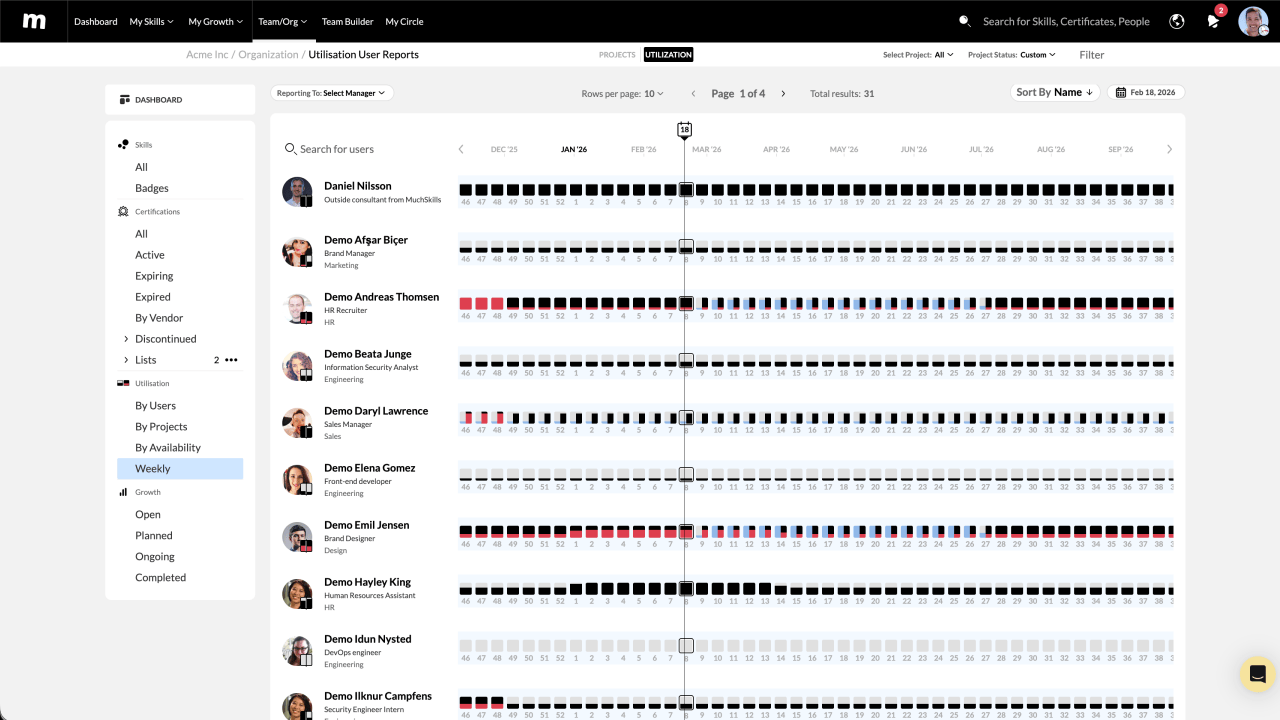
The most comprehensive view of your team's utilisation

Glanceable data that's easy to understand

All the skills in one place. And we mean ALL.

Interactive reports to easily understand what your team can deliver successfully

A clear breakdown of each employees weekly utilisation status

List the skills you need for a project, discover team members who can deliver

Easily understand where the skills gaps are per employee

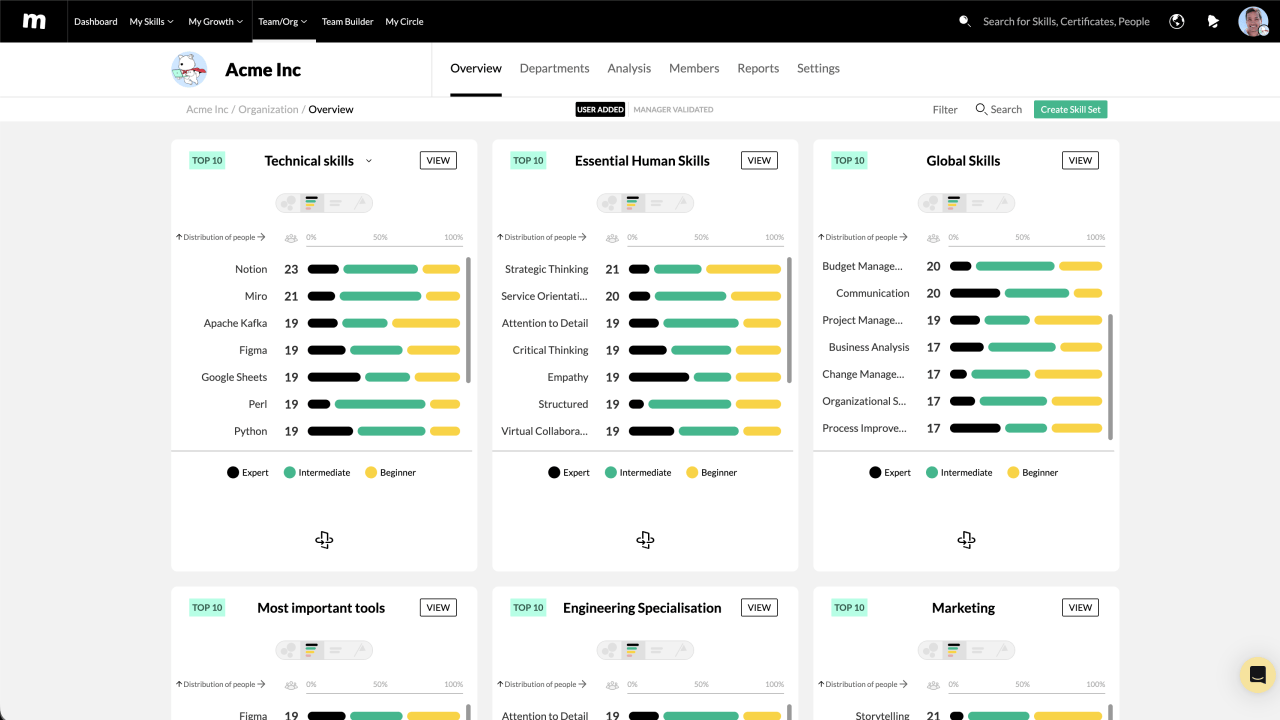
Keep a track of the skills that are important to your business in one place

An interactive timeline that reflects each employees skills growth over time

A quick break down of the important skills in one quick overview

Customisable learning data that's relevant to your team's learning needs

Discover the strengths, hidden skills, and favourite skills of each team member. Organise work more intelligently to increase employee engagement and productivity.
Conduct one-on-one sessions with employees that focus on developing their skills, encouraging them to learn new ones, and helping them create professional growth and development plans.
Perform skills gap analyses by role, competency, team member, or team. Use this knowledge to create strategic upskilling plans, or hire to acquire the skills you are missing.
By focusing on skills, strengths, and employee empowerment, you enable your team to perform at their best.






Depending on your needs, MuchSkills offers the following
Understand and forecast future talent needs and develop strategies to ensure the right skills are in place to meet business goals.
Learn how to build autonomous, agile, and high-performing teams by taking the skills-based approach
Train managers to identify potential workforce risks and gaps to proactively adress talent needs and mitigate risks.
Discover how the MuchSkills talent marketplace can aid the internal recruitment process to satisfy critical skill needs faster and more efficiently than external recruitment.
Plan for a more tactical Learning & Development strategy to ensure your employees training and upskilling goals and aligned to their interests as well as strategic business goals.
Learn how a better understanding of employee utilisation and planning can create a more balanced approach when looking and business & employee needs.


Discover research-based best practices for conducting engaging and valuable one-on-one meetings.

5 steps to build the strengths of your team members

A self reflection template to be used for employees before holding one-on-one meetings.
60% of employees say the ability to do what they do best in a role is “very important” to them. People who use their strengths at the workplace every day are:
more productive
less likely to quit their jobs
Organisations with higher employee engagement see 17% greater productivity.
According to a major study by Deloitte, skills-based organisations are:


Nearly 2 out of 3 software and IT projects are not fully successful because of poor staffing choices, according to the CHAOS 2020 report that studied over 50,000 projects. That is not always a talent shortage problem. It is also a talent visibility problem. Many times, organisations have the right people – they just cannot find them fast enough, or do not know they have them at all.
The cost shows up differently depending on how you measure it. For a manager running a delivery team, it is a project that slips. For an HR leader, it is a hire that was never necessary. For a consulting firm of 400 people billing at €120 per hour, a single percentage point improvement in utilisation represents over €600,000 in annual revenue recovered. At 3%, that is more than €2.5 million – from people who were already on the payroll.
Skills visibility is not a people initiative. It is a commercial one.
Firms that match employees to the work most suited to their skills are measurably more productive, and their ability to do so depends on the quality and experience of their management (Centre for Economic Policy Research, 2022). But even good managers are constrained by what they can see – and without reliable skills data, the best intentions produce imprecise decisions.
Making better use of employees' existing skills can improve productivity, reduce inequality, and contribute to economic growth. (OECD/ILO, 2017)
Highly engaged teams deliver 14% higher productivity, up to 18% higher sales productivity, and 23% higher profitability compared to low-engagement teams. (Gallup)
Low engagement, on the other hand, carries a real cost. Employees who are not engaged cost their company the equivalent of 18% of their annual salary. (Gallup, 2020)
Book a 30-minute demo and we'll show you exactly what skills visibility and capacity planning looks like for a team like yours.